One of my favorite things about writing science fiction is that I can create practically anything I want. I can destroy modern civilization, invent technologies that don’t exist, send humanity to distant planets, introduce entirely new species, or imagine what our world might look like thousands of years from now. Unlike writing a story set in the present day, where readers already understand how most things work, science fiction gives me the opportunity to create an entirely different reality with its own rules, history, societies, and problems.
But there’s also a downside to having that much freedom. The moment you start taking your fictional world seriously, you realize that almost every decision creates another dozen questions you haven’t answered yet. If your story takes place on another planet, you need to think about its climate, atmosphere, gravity, geography, resources, and living conditions. If you’re writing about a civilization that has survived an apocalyptic event, you’ll eventually have to consider how people obtain clean water, grow food, maintain buildings, produce electricity, and organize themselves without the institutions they previously depended on.
And things can become complicated surprisingly quickly. While researching ideas for my own science-fiction project, The FallReach Series, I started investigating what might happen to a modern city after twenty-five years without maintenance. I wanted to understand the condition of its roads, bridges, skyscrapers, drainage systems, tunnels, and other infrastructure. What began as a relatively simple research question turned into an investigation of how modern cities function, how interconnected their systems are, and what might happen when people are no longer available to maintain them.
That’s when I realized something important about worldbuilding: you don’t necessarily need more imagination; sometimes, you need better questions.
I’ve spent plenty of time writing character backgrounds, developing fictional locations, collecting research, and trying to organize everything into something that makes sense. I’ve also experienced the opposite, where researching one interesting detail leads to another, and suddenly I’ve spent an entire afternoon learning about something that might never appear in the actual book.
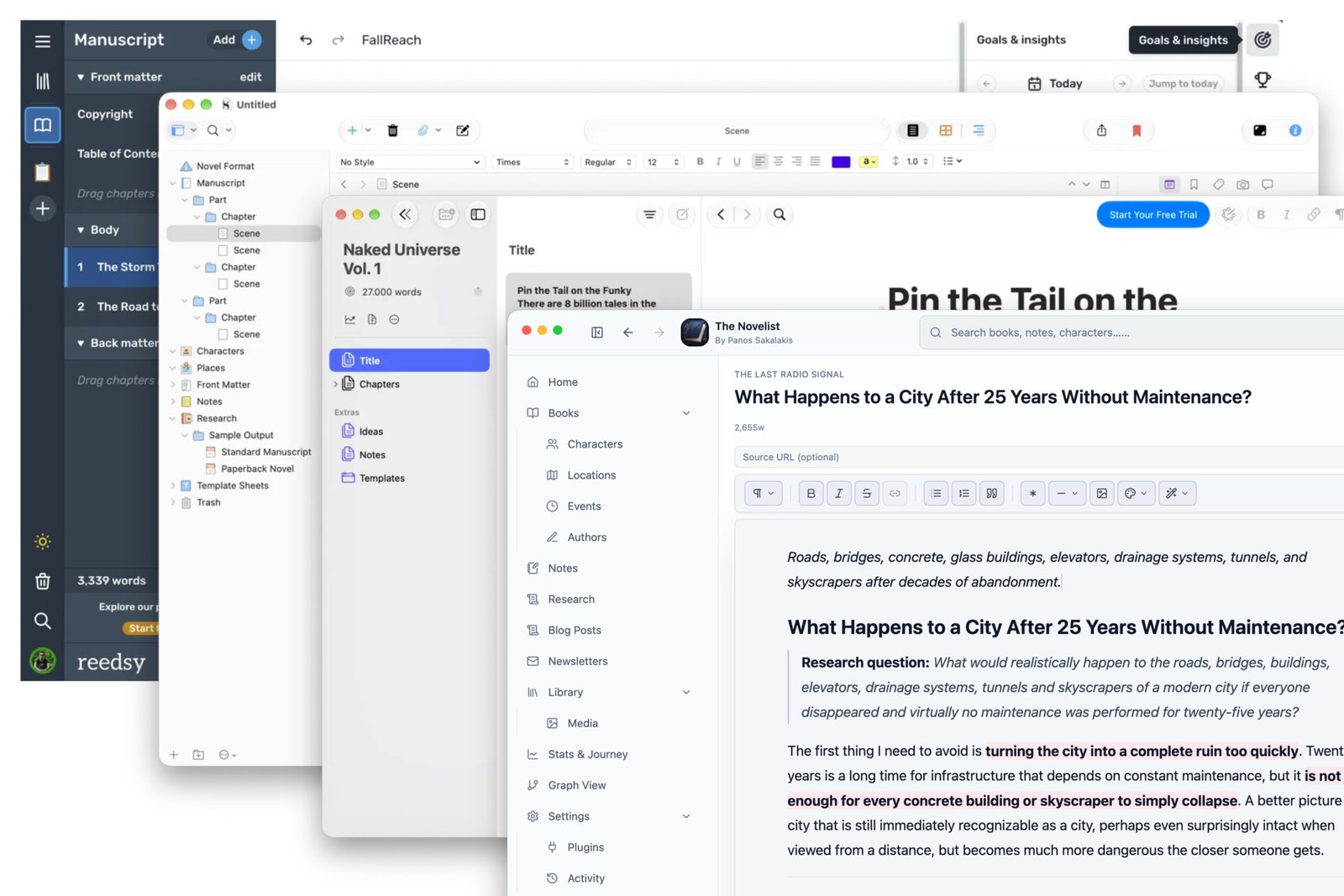
So, I decided to create a practical worldbuilding checklist that I could use for my own writing projects and share with other fiction writers. And because I also develop a writing and worldbuilding application called The Novelist, I designed the checklist so that every category can be organized within the application. You don’t need The Novelist to use it, though. A notebook, Google Docs, Obsidian, or any other writing tool will work perfectly well.
The goal isn’t to make worldbuilding more complicated but to help you figure out which questions are worth answering before those unanswered questions become problems in your manuscript.
Download the Free Sci-Fi Worldbuilding Checklist (Printable PDF)
I’ve created two versions of the checklist, both available completely free.
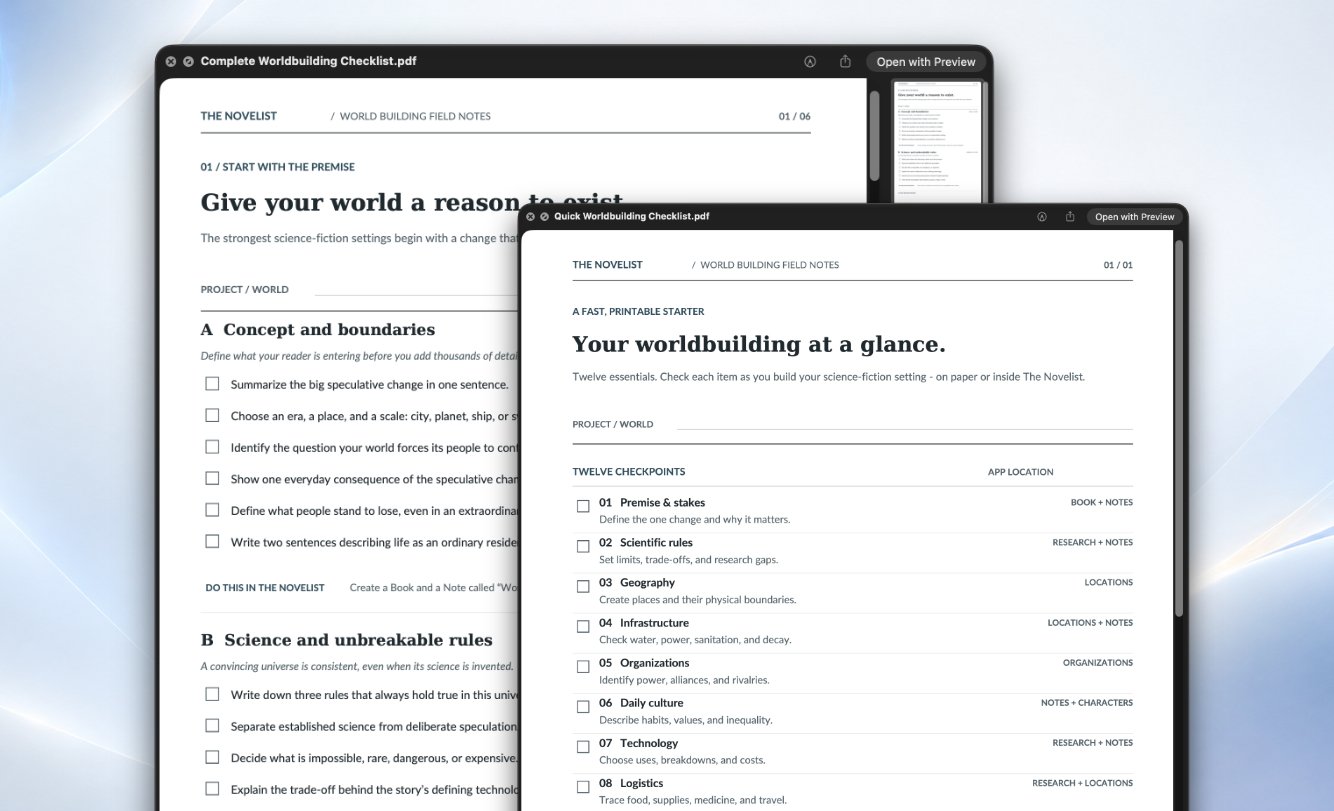
The Complete Sci-Fi Worldbuilding Checklist is a six-page printable PDF containing seventy-two tasks divided into twelve categories. It covers everything from scientific rules and environmental conditions to political organizations, character development, technological limitations, and story continuity. Each category also includes guidance on where to organize the information inside The Novelist.
The Quick Sci-Fi Worldbuilding Checklist is a one-page version containing the twelve most important checkpoints. It’s designed for writers who want something they can print, keep beside their keyboard, and consult while planning or revising their stories.
Both versions are designed for A4 printing, with a minimal, ink-friendly layout. You can complete the tasks in whatever order makes sense for your story, and you certainly don’t need to finish all seventy-two before you’re allowed to start writing.
In fact, I’d recommend doing the opposite: establish enough of your fictional world to make the opening chapters believable, start writing, and return to the checklist whenever your story introduces something that requires additional development.
Downloading for offline use or printing: Once you click either checklist, you can download the PDF by clicking the “Download” icon in the top-right corner.
Here’s what I think every science-fiction writer should consider
1. Start with your world’s premise and central rules
Before inventing a hundred fictional locations or designing the political structure of an interplanetary civilization, I think it’s worth answering a much simpler question: what makes your world different from ours?
Every science-fiction story introduces some kind of change, whether it’s a technological breakthrough, an environmental disaster, an alternate historical event, contact with extraterrestrial life, or a civilization that has evolved far beyond our current capabilities. That change doesn’t necessarily need to be spectacular. A story about people discovering that human memories can be transferred between bodies might be just as interesting as one involving an entire galaxy of inhabited planets. What matters is understanding how that change affects ordinary life.
If humanity has developed the technology to travel between stars, for example, how does that affect communication, trade, migration, government, and warfare? Can anyone afford interstellar travel, or is it restricted to wealthy individuals and powerful organizations? Do people still feel connected to Earth after several generations living elsewhere? If a journey takes months, years, or only minutes, how does that change the relationships between different colonies?
You don’t need to answer every question immediately, but your central premise should establish boundaries that help you make decisions later. Otherwise, it becomes tempting to invent new technological capabilities whenever the plot requires an easy solution.
Your first worldbuilding tasks:
- Summarize your world’s central premise in one or two sentences.
- Establish when and where the story takes place.
- Identify three rules that must remain consistent throughout the novel.
- Explain how the premise changes everyday life.
For my own projects, I find it helpful to write these rules separately from the manuscript. That way, whenever I introduce a new technology, location, or major event, I can check whether it contradicts something I’ve already established.
2. Decide how much scientific realism your story needs
Here’s something I think science-fiction writers sometimes misunderstand: a story doesn’t have to be scientifically perfect to be believable. Science fiction exists on a fairly broad spectrum. Some stories try to respect the scientific knowledge available to us today, while others introduce hypothetical technologies or physical phenomena that would fundamentally change our understanding of the universe.
Neither approach is automatically better, and I don’t think authors should feel obligated to turn every novel into a physics textbook. However, I do think readers deserve consistency. If you’ve established that traveling between planets takes several months, characters shouldn’t suddenly reach another planet in a few hours without an explanation. If your fictional civilization has limited access to energy, introducing an incredibly powerful machine should raise questions about how that machine operates, who controls it, and what happens when something breaks.
For stories involving space exploration, NASA’s educational resources are excellent starting points. Its explanation of habitable zones, for example, helps illustrate why a planet’s distance from its star matters when considering the possibility of liquid water. Of course, being inside a habitable zone doesn’t automatically mean a planet is habitable; atmospheric conditions, planetary characteristics, and other factors still matter.
Communication is another interesting example. According to NASA’s explanation of deep-space communications, signals traveling between Earth and Mars can experience delays of several minutes in either direction. Imagine trying to coordinate an emergency when every message takes that long to arrive. You don’t need to use real-world physics everywhere, but understanding it can help you decide where your fiction deliberately departs from reality.
Your scientific realism checklist:
- Decide which scientific principles your story follows.
- Identify technologies or phenomena that require fictional explanations.
- Establish limitations, costs, and potential failures.
- Keep a record of reliable sources and unanswered research questions.
One suggestion: whenever you’re researching something complicated, separate what scientists currently understand from what you’re inventing. A speculative explanation is perfectly acceptable in science fiction, provided you understand that it’s speculative.
3. Develop your geography, climate, and natural environment
I don’t think a fictional location becomes believable simply because you’ve given it a name and written a paragraph describing how beautiful or dangerous it looks. A location should influence what people can do, where they can travel, what resources they can access, and which dangers they encounter. Otherwise, it’s little more than a decorative background.
Let’s say you’re creating a settlement on a distant planet. Before describing its futuristic buildings and enormous mountains, think about why the settlement exists in that particular place. Perhaps there’s a reliable water source nearby, or the surrounding landscape provides protection against violent storms. Maybe an underground mineral deposit makes the location valuable enough for people to tolerate otherwise terrible living conditions.
The same principle applies to post-apocalyptic settings. A surviving community might establish itself near a river, but a river also introduces questions about flooding, contamination, access, and whether other groups can reach the settlement. Climate matters too. A city abandoned in a humid coastal region may experience different deterioration patterns from one located in an arid desert, and a planet with a different day length or seasonal cycle might affect its inhabitants’ routines in ways we don’t immediately consider.
I enjoy creating locations that seem attractive until you begin examining the practical disadvantages of living there. An isolated mountain settlement might be defensible against hostile groups but incredibly difficult to supply during winter. A city surrounded by water might offer natural protection while making drinking water and sanitation serious challenges.
Your environmental checklist:
- Define the most important geographical regions and locations.
- Establish the climate, weather, and environmental hazards.
- Identify essential resources and natural barriers.
- Consider how geography influences transportation and settlements.
If you’re building a large fictional world, organizing locations hierarchically can make a substantial difference. A planet contains regions, regions contain cities, and cities contain neighborhoods, buildings, and landmarks. Each level provides context for the next.
4. Think about infrastructure and what happens when it fails
This is one of my favorite worldbuilding subjects, especially when writing about abandoned cities or civilizations that have experienced a major collapse. We tend to think of modern cities in terms of buildings, roads, and recognizable landmarks, but those visible structures represent only part of an incredibly complicated system. Electricity, water distribution, wastewater treatment, transportation, telecommunications, healthcare, food delivery, and countless other services depend on people, equipment, supplies, and other infrastructure functioning together.
When one system fails, the consequences can spread into others. For example, a prolonged electricity outage could affect water pumping and treatment, mobile communications, transportation, and other essential services. These dependencies are documented in real-world emergency planning, including FEMA’s Power Outage Incident Annex.
Now imagine introducing those problems into a fictional world where nobody has been maintaining the infrastructure for twenty-five years. What happens to underground tunnels that experience repeated flooding? What happens to reinforced concrete exposed to moisture and corrosion? Which roads remain usable, and which become blocked by vegetation, erosion, debris, or damaged structures? What happens to elevators in buildings that haven’t had electricity or regular inspections for decades?
There isn’t a universal answer. The condition of an abandoned structure depends on its construction, environment, exposure, previous maintenance, and what has happened during those twenty-five years. Not every skyscraper will collapse, not every bridge will become unusable, and not every abandoned building will deteriorate at the same rate. But these questions can generate excellent storytelling opportunities.
For FallReach, I can imagine characters entering an abandoned city where some areas remain surprisingly recognizable while others have become dangerous to navigate. Perhaps an important route is blocked by a damaged bridge, forcing the characters to choose between crossing dangerous territory and searching for another way through the city.
That’s the kind of worldbuilding I enjoy: information that eventually influences the story.
Your infrastructure checklist:
- Establish how settlements obtain electricity, water, food, and sanitation.
- Decide which systems have failed, survived, or been repaired.
- Identify dangerous structures and neglected infrastructure.
- Explain who maintains whatever technology and equipment still works.
If your story takes place hundreds or thousands of years into the future, the technologies may be completely different, but the underlying question remains relevant: what does this civilization depend on, and what happens when those dependencies fail?
5. Create governments, factions, and organizations that make sense
I love fictional worlds containing multiple factions, especially when those groups have conflicting motivations and complicated relationships. However, I think it’s easy to fall into the trap of creating organizations that exist primarily because the plot needs an enemy. A believable organization needs something more substantial than a threatening name, a recognizable symbol, and a leader who enjoys giving dramatic speeches.
Start by deciding what the organization actually wants. Does it control territory, distribute food, protect a particular population, preserve knowledge, maintain religious traditions, or regulate access to valuable technology? Then consider how it achieves those goals, who benefits from its existence, and why ordinary people might support it.
Even organizations with questionable methods should have understandable motivations. A faction that restricts access to medicine might claim that strict rationing is necessary for survival. Another group might oppose those restrictions because it believes the medicine should be available to everyone. Both sides could have legitimate concerns, selfish interests, or hidden agendas. That’s much more interesting to me than dividing an entire fictional world into obviously good and obviously evil groups.
You should also think about how organizations interact with the physical environment. If one faction controls the only functioning water-treatment facility within hundreds of kilometers, it might hold tremendous influence even without an especially powerful military. A different faction could control transportation routes, agricultural land, communications equipment, or access to historical information. Political power often becomes easier to understand when you follow the resources.
Your organizations checklist:
- Identify the major governments, factions, and organizations.
- Establish their goals, resources, and methods.
- Create meaningful alliances, rivalries, and conflicts.
- Decide how ordinary people experience their authority.
For my own stories, I also like recording what an organization publicly claims to believe and what its leadership actually knows or wants. Those two things don’t always need to be the same.
6. Don’t forget everyday life, culture, and social class
When I think about the fictional worlds that stay with me long after finishing a book, it’s usually not because I remember every detail about their military technology or political history: it’s because I remember how people lived. The things characters eat, the jobs they perform, the stories they tell their children, the traditions they maintain, and the ways they interact with strangers can reveal an enormous amount about a fictional civilization.
Consider a society that has survived underground for several generations. Its inhabitants might develop completely different attitudes toward sunlight, open spaces, privacy, personal possessions, and the outside world. Children who have never seen the sky might understand the concept intellectually without having any emotional connection to it. Or imagine a technologically advanced civilization where artificial intelligence performs nearly every form of physical labor. That technological development might affect education, social status, economics, politics, and people’s sense of purpose.
Culture should also differ between communities. Two settlements living under the same government may still have very different traditions, values, dialects, and opinions about historical events. I find that introducing small disagreements between characters can be a particularly effective way to reveal those differences. Something considered polite in one community might be offensive in another, or a character might misunderstand an unfamiliar custom because they grew up somewhere else.
You don’t need to explain the entire cultural history to make the scene work – sometimes a brief interaction is enough.
Your culture checklist:
- Describe ordinary work, education, food, and family life.
- Establish traditions, social rules, beliefs, and taboos.
- Decide how money, barter, status, and inequality function.
- Show how different communities interpret the same events.
One useful exercise is to write a paragraph describing an ordinary morning in your fictional world, without mentioning the main character or the novel’s central conflict. If you struggle to imagine what an average person does after waking up, you may have found an area worth developing.
7. Give your technology limitations and consequences
Inventing technology is one of the most enjoyable parts of science fiction, and I certainly understand the temptation to create devices capable of doing almost anything. But I think technology becomes more interesting when it introduces new problems instead of solving every existing one.
For example, a fictional medical device that can heal severe injuries within minutes. That’s a fascinating invention, but it also raises plenty of questions. Is it expensive? Does it require rare materials? Can it repair every type of injury? Does it have side effects? Who has access to it? Can it malfunction? Now imagine that only a small percentage of the population can afford the treatment. Suddenly, what began as a technological invention has become a source of social conflict.
Transportation technology works the same way. If spacecraft can travel faster than light, consider the energy requirements, limitations, and consequences of that ability within your fictional universe. If intelligent machines perform essential tasks, consider what happens when those systems lose access to the resources they need. Even a technological failure can become an opportunity for character development. A person who has spent their entire life depending on automated systems might struggle when those systems become unavailable, while someone familiar with older methods could suddenly become extremely valuable.
Your technology checklist:
- List the technologies that significantly affect everyday life.
- Establish their limitations, resources, and maintenance requirements.
- Decide who controls, understands, and can repair them.
- Identify potential failures and unintended consequences.
I recommend avoiding technologies that exist only to solve one specific scene and are never mentioned again. If a device is powerful enough to save the protagonist in chapter ten, readers may reasonably wonder why nobody uses it when another problem appears in chapter twenty.
8. Work out resources, logistics, and survival
This is where I think many fictional worlds begin to reveal problems their authors haven’t considered. A city might look incredible, a futuristic spaceship might be beautifully designed, and a hidden settlement might seem like the perfect place for characters to survive. But eventually, somebody needs to eat. Where does the food come from?
It’s such a simple question, yet answering it can reveal a surprising amount about how a society functions. If your civilization lives underground, perhaps it relies on controlled agriculture, stored supplies, trade, or some fictional food-production technology. Each explanation creates additional questions about energy, water, equipment, labor, and vulnerability. The same principle applies to medicine, clean water, replacement parts, fuel, and practically every resource people depend on.
Think about transportation too. If characters travel between distant settlements, establish the journey time and the problems they might face along the route. Walking through a ruined urban area isn’t necessarily equivalent to walking along a maintained road, and transporting valuable supplies through dangerous territory could require planning, security, and suitable equipment.
The point isn’t to calculate every calorie a character consumes or document every piece of machinery in your fictional city. It’s to understand the systems well enough that the story doesn’t accidentally contradict them.
Your resources checklist:
- Establish how communities obtain food, water, and medicine.
- Identify important supply routes and transportation methods.
- Decide which resources are scarce, valuable, or controlled.
- Determine what happens when an essential supply disappears.
Here’s an exercise I like: choose one ordinary meal and follow its ingredients backward through the world. Where were they produced? How were they transported? Who prepared them? Who could afford them?
By the time you’ve answered those questions, you’ve probably discovered several interesting details about your fictional society.
9. Create characters who belong to your world
One thing I try to remind myself when developing characters is that they shouldn’t feel as though they could be removed from one fictional universe and dropped into another without anything changing. Their environment should influence their personalities, beliefs, fears, goals, and experiences.
Someone who has survived in a dangerous post-apocalyptic city since childhood will probably view the world differently from a person who grew up inside a secure settlement with access to food, education, and modern technology. Their understanding of danger, trust, morality, and personal responsibility might be completely different, even if they’re approximately the same age.
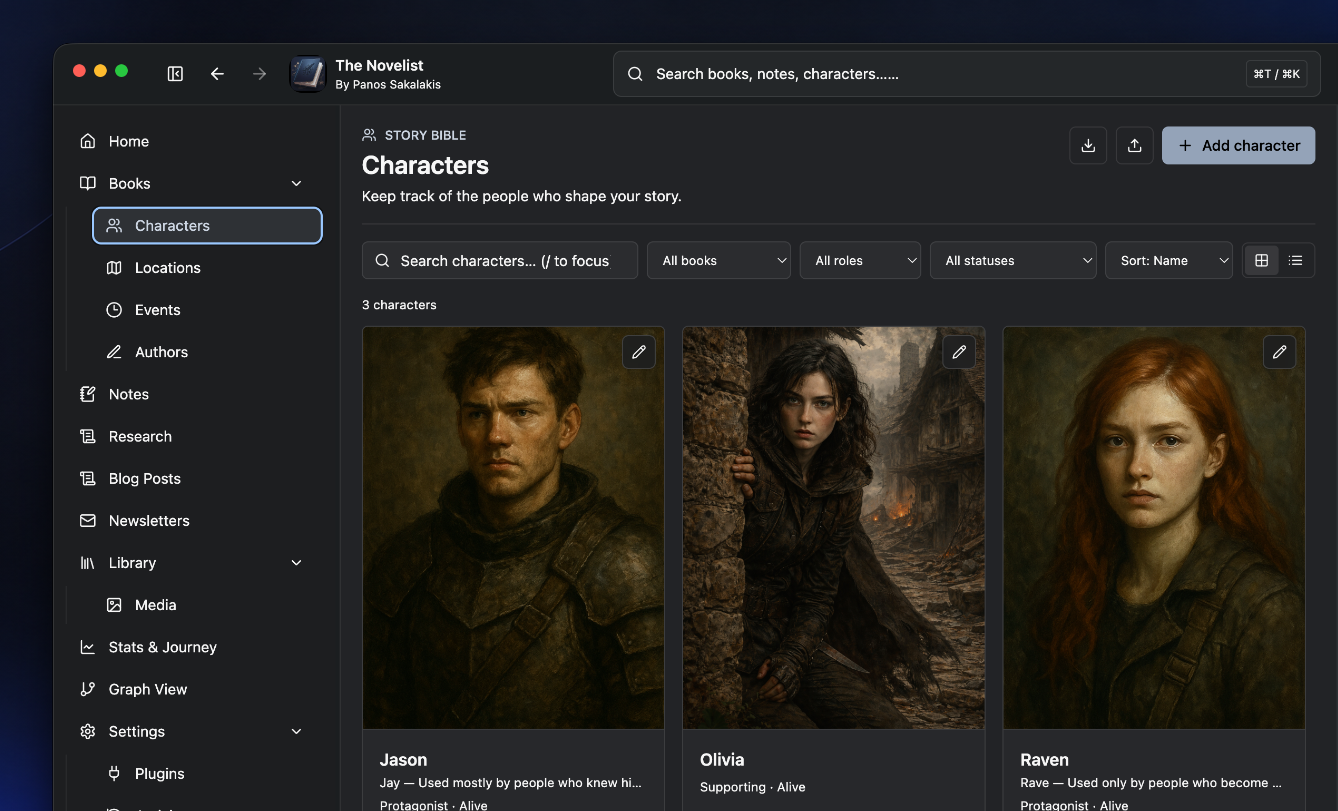
For FallReach, I want the characters to feel like people who have genuinely been shaped by their circumstances. Jason, Raven, and Olivia shouldn’t simply exist to move the plot forward. Their experiences should affect how they interpret events, how they react to unfamiliar people, and which decisions they’re willing to make when circumstances become difficult. I also think flaws are important. If a character has survived for years by refusing to trust strangers, that approach may have kept them alive, but it could also prevent them from forming relationships when cooperation becomes necessary.
That’s the kind of internal conflict that can develop naturally from worldbuilding.
Your character checklist:
- Establish each important character’s goals, fears, flaws, and history.
- Explain how their environment has shaped their personality.
- Define their relationships, loyalties, and conflicts.
- Decide what each character knows, believes, or misunderstands about the world.
A useful test is to ask yourself whether a particular character would make the same decisions if they had grown up in a completely different environment. If the answer is always yes, their background might not be influencing the story enough.
10. Build a history that still affects the present
Science-fiction worlds often contain fascinating histories, especially when they take place long after a major disaster, political transformation, technological breakthrough, or interplanetary expansion. But I don’t think there’s much value in writing fifty pages of fictional history if none of it has any influence on the story you’re telling.
History becomes interesting when its consequences remain visible. Maybe an old war explains why two settlements refuse to cooperate. An unsuccessful scientific experiment might have forced an entire population to abandon its home. A political decision made several generations ago could explain why certain people have access to advanced technology while others do not.
I also enjoy the idea that different people might have completely different interpretations of the same historical event. What one organization celebrates as a victory might be remembered as a tragedy by another. An event that appears accidental in official records might have been deliberately caused. A character could discover that the story they’ve believed their entire life is incomplete or intentionally misleading. These details can create mysteries, character conflicts, and unexpected changes in the direction of your plot.
For a post-apocalyptic story, establishing a clear timeline is especially important. If civilization collapsed twenty-five years before the events of your novel, consider which characters were alive before the disaster, who remembers the old world, and which generations have grown up knowing nothing else.
Your history checklist:
- Identify the events that shaped the current world.
- Establish a timeline of major historical turning points.
- Decide which historical facts are disputed, misunderstood, or concealed.
- Explain how past events still influence the present.
I also recommend checking character ages against your timeline. It’s surprisingly easy to give someone memories of an event that happened before they were born, particularly when you’re working on a long story with multiple generations.
11. Make sure your worldbuilding actually appears in the story
This might be the most important part of the entire checklist.
You can spend months creating an incredibly detailed fictional universe, complete with maps, character biographies, political histories, technological explanations, and thousands of words of research. But readers aren’t going to experience that information unless it becomes part of the story. And even then, you don’t necessarily want to explain everything.
I think there’s a difference between a world feeling detailed and a novel constantly reminding readers how detailed its world is. A character doesn’t need to deliver a three-page explanation of how a water-treatment facility works simply because you’ve spent several days researching the subject. Instead, let the information influence what’s happening. Maybe the characters arrive at a settlement where access to clean water is restricted. Perhaps somebody becomes ill after drinking from an unsafe source, or an important negotiation takes place because two communities depend on the same functioning infrastructure.
Those situations reveal information about the world while also affecting the plot, and the same principle applies to technology, politics, culture, and history. Whenever possible, I prefer showing the consequences of worldbuilding through decisions, obstacles, relationships, and conflicts instead of stopping the story to deliver a lecture.
Your storytelling checklist:
- Introduce important worldbuilding details through scenes and character experiences.
- Use environmental conditions, technology, and social rules to create meaningful obstacles.
- Avoid explaining information the reader doesn’t currently need.
- Make sure important elements influence the plot or characters.
One exercise is to take a paragraph explaining your fictional world and ask yourself whether the same information could be revealed through an interaction between characters. You might discover that a scene communicates the information more naturally while also giving readers another reason to care about the people involved.
12. Check your world for contradictions before they become plot holes
There’s one final problem (well, probably not the final, but that’s all I can remember for now) that becomes more difficult as your manuscript grows: remembering everything you’ve already established. With a short story, keeping track of the details might not be challenging. But when you’re working on a full-length novel containing dozens of characters, multiple locations, a complicated timeline, and hundreds of pages of research, small contradictions can become increasingly difficult to notice.
You might accidentally change the distance between two settlements, forget that a character already learned an important secret, or introduce technology that contradicts an earlier explanation of how your fictional world works. Sometimes these mistakes are harmless. Other times, they can undermine an important part of the story. This is why I think keeping a separate collection of worldbuilding information is so useful. Instead of relying entirely on memory, you can refer to established facts while writing and compare them against new developments.
I also find it helpful to distinguish between information that is definitely established and ideas that I’m still considering. Otherwise, something written down during an early brainstorming session can easily be mistaken for a final decision several months later.
Your continuity checklist:
- Verify important dates, character ages, and historical events.
- Check that technology and scientific rules remain consistent.
- Confirm geography, travel times, and resource availability.
- Review what each character knows at different points in the story.
And please, regardless of which writing application you use, make proper backups of your manuscript and worldbuilding information. Losing an afternoon of research is annoying enough, but losing several months or years of creative work would be so much worse.
How I organize all of this inside The Novelist
If you’ve ever tried organizing an entire fictional universe using separate documents, spreadsheets, bookmarks, and folders, you probably understand how quickly things can become difficult to manage. I’ve certainly been there.
One of the reasons I started developing The Novelist was that I wanted a dedicated writing environment where my manuscript, characters, locations, research, and other story-related information could exist together without requiring me to create an elaborate system from scratch. The application is currently in Early Access, and I’m still improving it, but its central idea is fairly straightforward: writing a novel and building its fictional world should feel like connected activities rather than completely separate projects.
For example, I can create a book, divide it into Parts and Chapters, and write the manuscript inside the editor. Alongside that manuscript, I can organize the characters, locations, events, organizations, and secrets that belong to the fictional world. Characters can have their own information, including backgrounds, personalities, goals, fears, flaws, relationships, and other details. Locations can be organized hierarchically, which is pretty useful when working with fictional cities, regions, planets, and more specific places within them.
I can also keep research and notes alongside the project, which helps when I’m investigating something complicated, such as how abandoned infrastructure might deteriorate over several decades. And because different elements of a fictional world are often connected, The Novelist includes a Story Bible with links between relevant information and the manuscript.
Here’s how I’ve organized the twelve categories from this checklist around the application:
- Books and Notes: The central premise, main rules, and general information about the fictional world.
- Research: Scientific information, technological explanations, and sources I want to revisit.
- Locations: Planets, countries, cities, settlements, districts, and important buildings.
- Organizations: Governments, factions, communities, and other influential groups.
- Characters: Personalities, biographies, motivations, flaws, relationships, and character development.
- Events and Secrets: Historical timelines, major turning points, hidden information, and mysteries.
- Chapters and Chapter Notes: The manuscript itself, along with questions and ideas I want to revisit while writing.
I should also mention that the core writing and worldbuilding features are available in The Novelist’s Free edition. You don’t need to purchase Pro to create characters, organize locations, maintain research, develop your Story Bible, or write your chapters. The Pro edition provides additional features, including the Graph View and other advanced tools, but none of those are required to complete this checklist.
And because The Novelist is designed around local-first storage, my writing remains on my own computer instead of requiring a constantly active connection to somebody else’s servers. That approach appeals to me, although I understand why some authors prefer browser-based applications with automatic cloud synchronization.
If you already have a system that works for you, keep using it. But if you’re interested in trying a dedicated desktop application for writing and worldbuilding, you can explore The Novelist and download the Free edition here.
A few things I’d avoid when worldbuilding a science-fiction novel
Before finishing, I want to mention several mistakes that I think are easy to make when you’re excited about developing a fictional universe.
The first is researching everything before writing anything. I love researching complicated subjects, but I’ve learned that there’s a point where gathering information stops being productive and becomes an excuse to avoid the difficult work of writing. Your fictional world doesn’t need to be completely finished before you start the manuscript, and some of your best ideas may only appear once the characters begin interacting with it.
The second is creating information that never influences the story. There’s nothing wrong with developing extensive background material for your own enjoyment, especially if you’re writing a series, but I wouldn’t assume that readers need to know every historical event, political organization, or technological invention you’ve imagined. Sometimes the most effective worldbuilding involves details you understand as the author but deliberately leave unexplained.
Another mistake is forgetting that ordinary people still need ordinary things. Even in a civilization capable of traveling between galaxies, somebody has to maintain equipment, transport supplies, resolve disagreements, raise children, and deal with the less glamorous aspects of daily life. Those details might seem less exciting than futuristic weapons or enormous spacecraft, but they often make a fictional world feel much more convincing.
And finally, I’d avoid designing your fictional society as though everybody living within it shares the same beliefs, experiences, and priorities. Real societies contain disagreements, inequalities, traditions, misunderstandings, and conflicting interpretations of history. Your fictional civilizations will usually become more interesting when their inhabitants have reasons to see the world differently.
I think one of the most satisfying experiences in writing science fiction is reaching the point where a fictional world begins to feel like a real place. Characters develop histories that influence their decisions, locations acquire details that make them recognizable, and events that happened decades before the story suddenly become relevant to what’s happening in the present. That’s when worldbuilding starts paying off.
But getting there doesn’t necessarily require hundreds of pages of background information or a perfectly organized encyclopedia containing every imaginable detail about your fictional universe. Sometimes, it simply requires asking the right questions and keeping track of the answers. That’s what I wanted this checklist to accomplish. Whether you’re writing about humanity’s first colony on another planet, an abandoned Earth centuries after civilization collapsed, a future society controlled by powerful corporations, or a fictional universe containing entirely new forms of life, I hope these exercises help you identify the details that matter most.
You can download the complete six-page checklist with seventy-two tasks, or use the simpler one-page version if you prefer something you can keep beside your keyboard. Both are free, printable, and designed to work with practically any writing setup. And if you’d prefer organizing everything digitally, The Novelist provides a dedicated workspace for developing your fictional world alongside your manuscript.
Whatever you decide to use, there’s one thing I’d keep in mind: a believable fictional world doesn’t need an answer to every imaginable question. It needs enough consistency, depth, and consequences to make readers believe that life continues beyond the pages of your story.
The rest can develop while you’re writing.
I’m Panos Sakalakis, a writer, blogger, and developer currently building The Novelist, a desktop application for novel writing and worldbuilding. I’m also working on my own science-fiction projects, and I enjoy exploring the research, technology, and creative challenges involved in bringing fictional worlds to life.
If you found this checklist useful, feel free to share it with another writer who’s building their own universe.